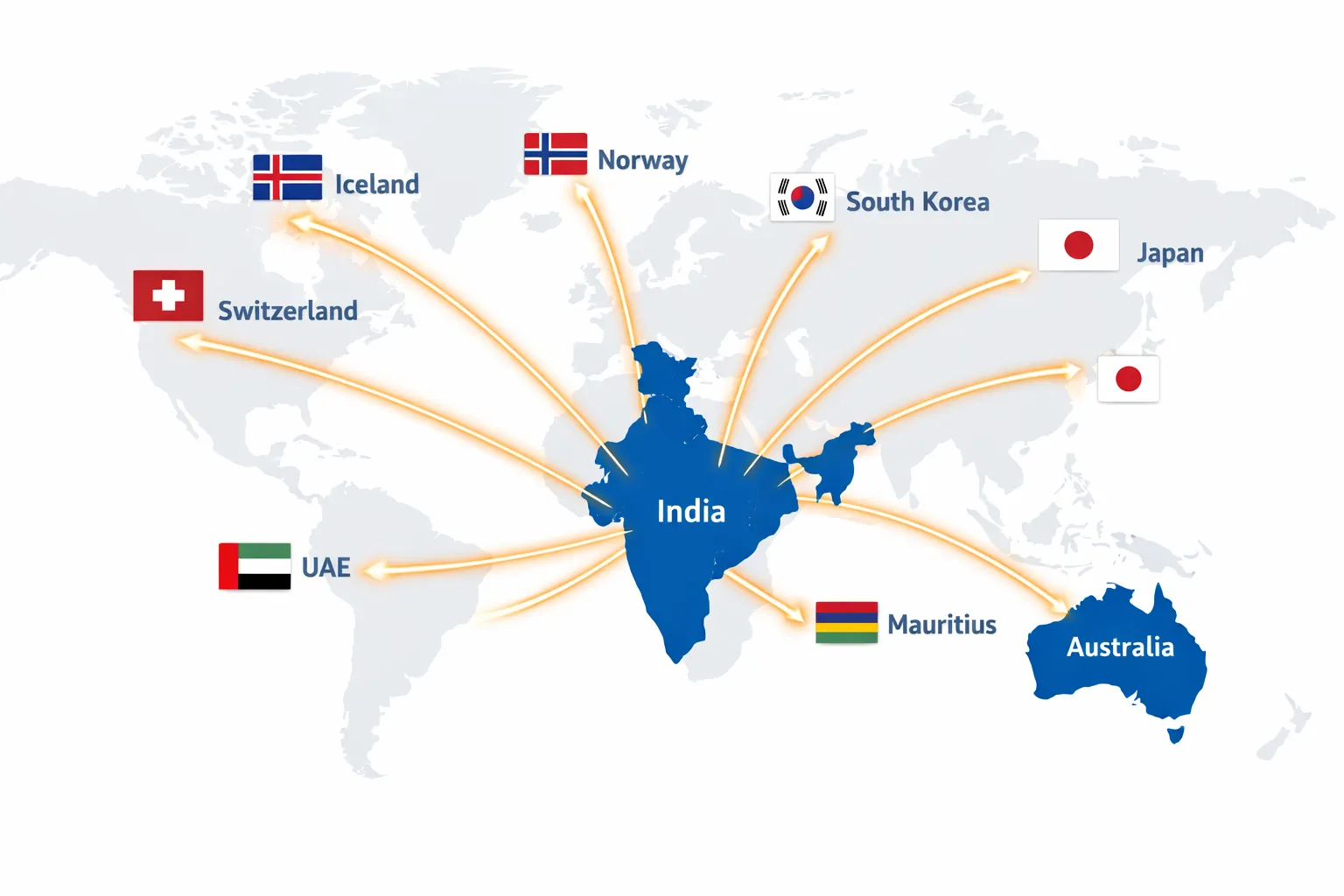
India’s Free Trade Agreement expansion is entering a decisive phase that will significantly influence global garment trade flows across several premium international markets. Ongoing negotiations with Japan, Australia, South Korea, Switzerland, Norway, Iceland, Mauritius and the United Arab Emirates are expected to reshape how international apparel brands manage sourcing, import duties, customs clearance and long-term manufacturing partnerships.
For fashion retailers, private label brands and multi-market distributors, these developments are not limited to trade diplomacy. They directly affect landed cost economics, supply chain risk profiles and long-term margin stability within the global garment trade.
Why FTAs Are Reshaping the Global Garment Trade
Most knitted garments, including T-shirts, sweatshirts, hoodies, joggers, loungewear, sleepwear and babywear, fall under HS codes 6101 to 6117. Import duties in Japan, Australia, South Korea, Switzerland and several European markets currently range between 8 percent and 18 percent, depending on classification and product composition.
FTAs are structured to provide preferential or zero-duty access for qualifying Indian-origin garments that comply with rules of origin documentation. Once these FTAs are fully implemented, brands importing garments from India will experience a direct reduction in landed costs.
This creates immediate commercial advantages within the garment trade, including:
Improved gross margin stability
Enhanced distributor and retailer pricing flexibility
Stronger competitiveness in promotional campaigns
Reduced exposure to duty volatility
Better long-term pricing predictability
These are structural changes, not temporary incentives, making FTAs a major force reshaping global garment trade patterns.
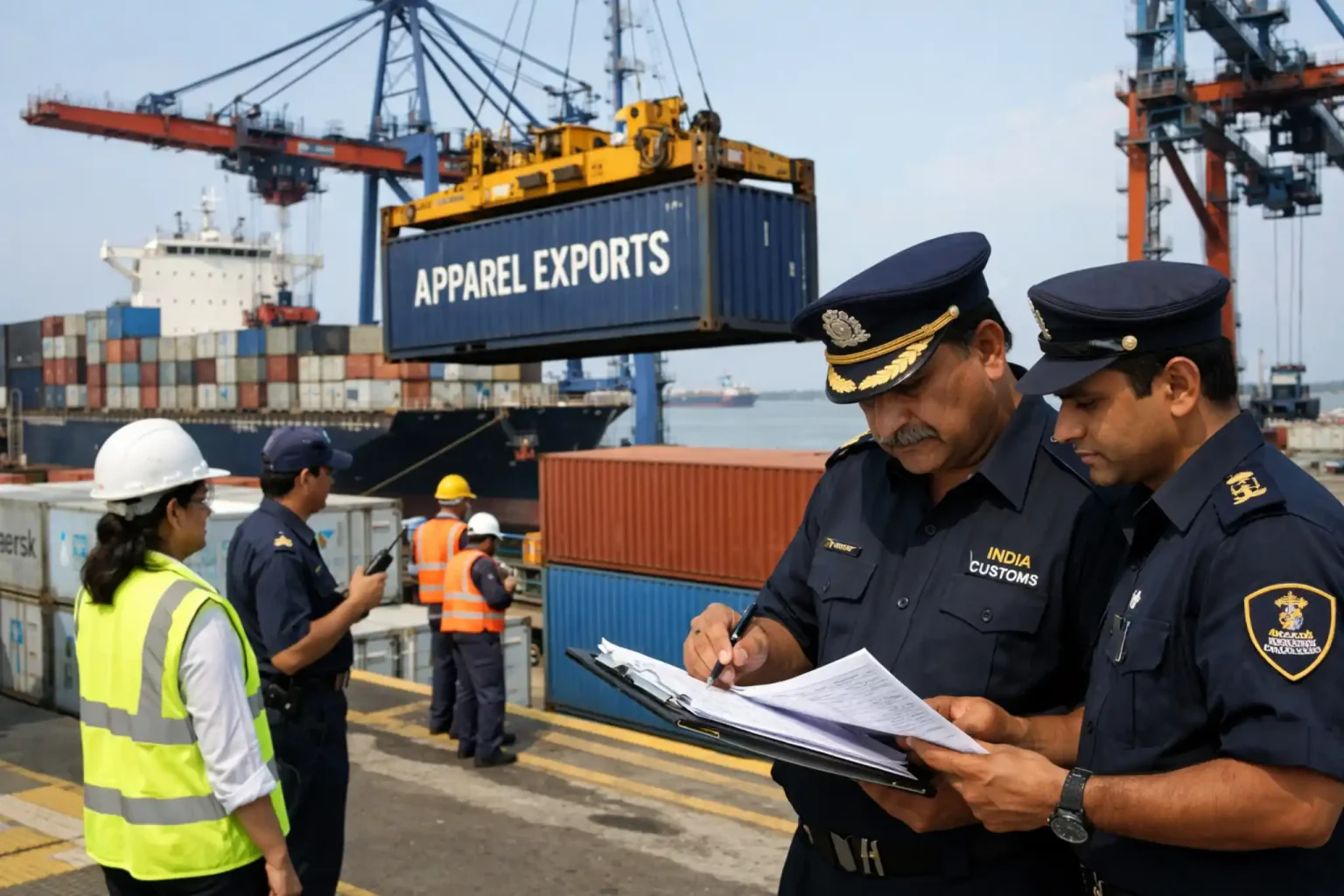
Faster Customs Clearance and Trade Facilitation Benefits
Beyond duty reduction, FTAs introduce procedural improvements that significantly affect the operational side of garment trade:
Simplified rules of origin certification
Reduced inspection frequency
Priority customs processing
Shorter port dwell times
Lower demurrage and detention risk
For apparel brands operating on seasonal, capsule and replenishment-driven models, these improvements translate into:
Faster product launches
Reduced stock-out risks
Improved inventory turnover
More predictable cash flow cycles
In competitive retail markets, customs clearance efficiency is often as important as product cost. FTAs therefore improve both cost and speed components of garment trade.
Strategic Markets Driving the Next Phase of Garment Trade
The countries currently negotiating FTAs with India represent some of the most influential markets in global garment trade:
Japan and South Korea emphasize technical performance, quality consistency and fast replenishment cycles.
Australia and Norway focus heavily on sustainability, traceability and ethical manufacturing.
Switzerland and Iceland serve premium private label and boutique apparel segments.
Mauritius operates as a trade and logistics hub for regional fashion distribution.
UAE functions as a major consumer market and re-export gateway for the Middle East and Africa.
These markets collectively represent high-value, compliance-oriented segments of the global garment trade. FTAs allow India to integrate structurally into these supply chains.
Why India Is Structurally Aligned With Global Garment Trade Standards
India’s manufacturing ecosystem offers several long-term advantages for global garment trade:
Yarn-to-garment integrated supply chains
Availability of GOTS and OEKO-TEX aligned textile programs
BSCI, WRAP and SEDEX audited manufacturing units
Skilled labor base and long-standing export expertise
Stable export incentive frameworks and trade facilitation systems
Clusters such as Tiruppur have decades of experience serving international apparel brands, making them well prepared to support the compliance, documentation and quality standards required under FTA frameworks.
| Country / Bloc | FTA Status |
|---|---|
| Japan | ✓ FTA signed & active |
| Australia | ✓ Trade agreement signed & active |
| UAE | ✓ CEPA signed & active |
| South Korea | ✓ CEPA (FTA-equivalent) signed & active |
| Mauritius | ✓ FTA signed & historically active |
| Switzerland, Norway, Iceland | ✓ EFTA TEPA signed & effective from Oct 2025 |
| Liechtenstein | ✓ Part of EFTA TEPA (effective from Oct 2025) |
| Pending / Under negotiation | EU FTA, USA trade agreement (ongoing) (not in list) |
What Apparel Brands Are Preparing For
Brands targeting Japan, Australia, South Korea, Switzerland, Norway, Iceland, Mauritius and UAE are already aligning their garment trade strategies by:
Establishing certified Indian supplier networks
Developing standardized fit libraries and size blocks
Creating scalable core SKUs
Aligning documentation workflows
Building replenishment-ready production programs
Brands that prepare early will be able to activate preferential trade benefits immediately when FTAs are implemented.
Implications for the Future of Global Garment Trade
The upcoming FTAs represent a structural shift in how international brands manage garment trade relationships. India’s advantage is not solely cost-driven. It is built on:
Policy stability
Compliance readiness
Trade facilitation frameworks
Manufacturing scale capability
Integrated textile supply chains
Together, these elements reduce long-term sourcing risk while improving landed cost efficiency.
Strategic Outlook
As these FTAs are finalized, India is positioned to become one of the most structurally stable and compliance-ready hubs in the global garment trade. Brands that align their sourcing and documentation infrastructure today will gain early-mover advantages in pricing control, margin retention and replenishment speed.
The next decade of global garment trade will be shaped by policy-aligned, compliance-ready sourcing hubs. India is preparing to lead that transformation.